Lets discover why real estate remains the top long-term investment for Americans. More people prefer real estate over stocks, bonds, and cryptocurrencies.
When it comes to long-term investments, Americans have a clear favorite: real estate.
According to a recent Gallup poll, 36% of Americans believe real estate is the best long-term investment, outpacing stocks (22%), gold (18%), savings accounts (13%), bonds (4%) and cryptocurrencies (3%).
Why is that the case? Let’s dive into why so many people believe that owning property is the ultimate way to build wealth over time.
The Popularity of Real Estate as a Long-Term Investment
For 11 years running, real estate has consistently topped the list of preferred long-term investments in Gallup’s annual Economy and Personal Finance survey.
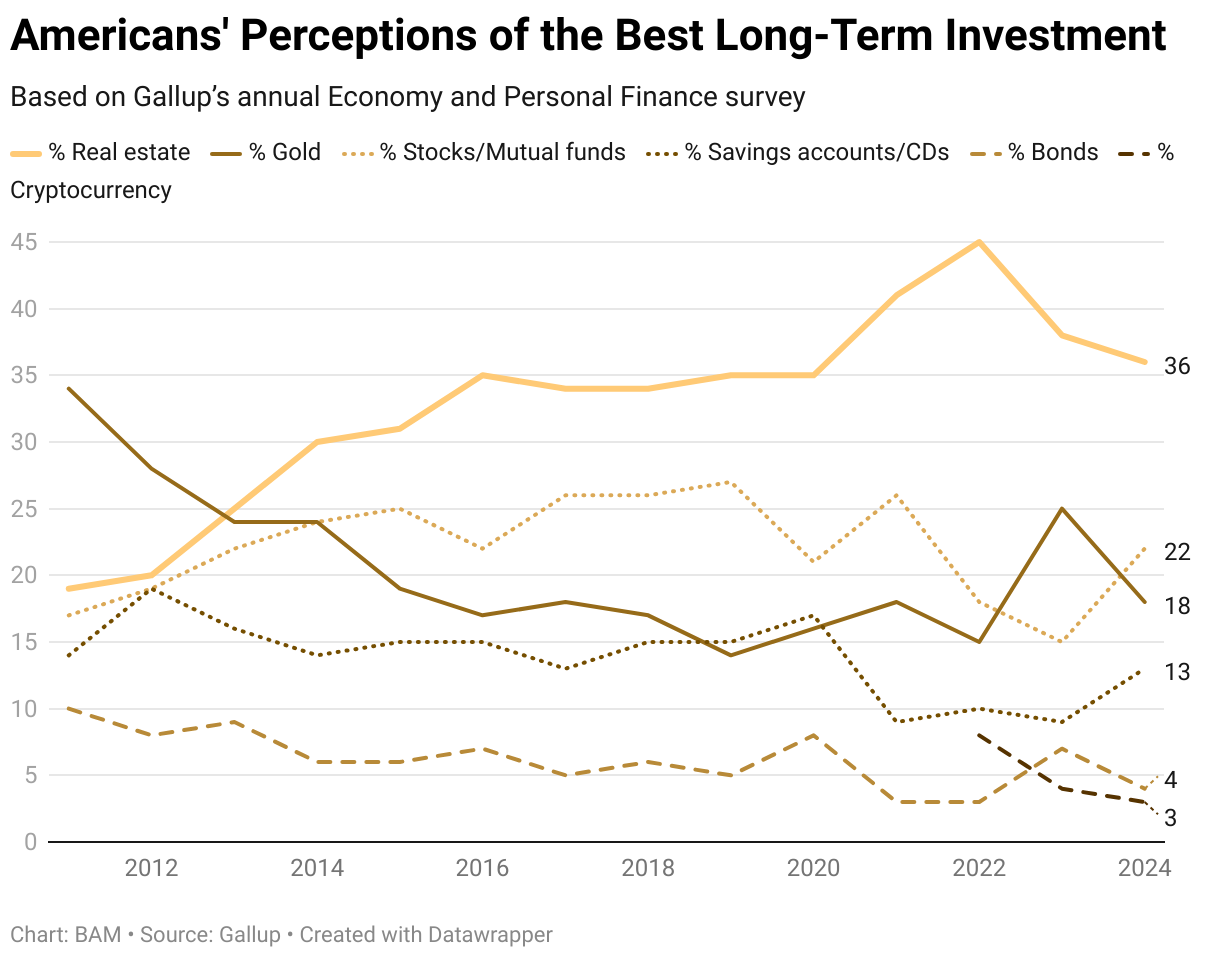
This preference for real estate is driven by several factors:
Tangible Asset: Unlike stocks or bonds, real estate is a tangible asset that you can see and touch. This physical presence provides a sense of security that is hard to match.
Appreciation Over Time: Historically, real estate values have shown steady appreciation. From the 1990s to the 2020s, home prices have consistently increased, making real estate a reliable investment.
Dual Benefits: Owning a home provides not only potential financial returns but also a place to live. This dual benefit is unique to real estate and adds to its appeal.
Gallup’s poll found this preference holds true across all income levels, with 33% of lower-income households stating they believe real estate is the best long-term investment, along with 36% of middle-income households and 40% of upper-income households.

Real Estate vs. Other Investments
While real estate is the top choice for many, it’s important to consider how it stacks up against other investments. Stocks, for example, have historically offered higher returns. From 1990 to April 2024, the S&P 500 surged by 1,325%, while the S&P CoreLogic Case-Shiller U.S. National Home Price Index rose by 308%.
However, stocks come with higher volatility. Real estate, on the other hand, tends to provide more stable growth. Even during economic downturns, such as the Great Financial Crisis of 2008, real estate has shown resilience and recovery.
This is highlighted when you look back at U.S. home price growth by the decade.

U.S. home price growth by decade:
1990s: +30.1%
2000s: +47.3%
2010s: +44.7%
2020-2024: +47.1%
Locally, home prices have risen XX% over the past year, and XX% since 2020.
Is Real Estate the Right Investment for You?
Real estate can be a fantastic long-term investment, especially in a growing market like [Market]. But before diving in, consider your individual situation:
Long-Term Commitment: Buying a home is a long-term play. If you plan to move in a few years, it might not be the best fit.
Financial Strength: Real estate requires a down payment, closing costs, and ongoing maintenance expenses. Make sure you have a solid financial foundation.
Investment Goals: Consider your overall investment goals. If you prioritize high returns and easy access to your money, another investment might be a better fit.
And keep in mind that diversification leads to a balanced investment strategy. Financial experts recommend spreading investments across various assets to hedge against different market forces and increase the odds of a net profit over the long term. This means integrating real estate within a broader portfolio that includes stocks, bonds, and other investment vehicles.
Bottom line: While poll results show that Americans prefer real estate as a long-term investment, there is no one-size-fits-all answer. Always consult with your financial advisor when planning to invest for your future, as the best option depends on your financial goals, risk tolerance, and investment timeline.
Comments
Post a Comment